

Relocating a workplace can quickly turn into a juggling act, especially for office managers balancing staff needs and daily demands in Monmouth County, NJ. A well-planned move means fewer headaches, less downtime, and a smooth switch to a new space. This guide focuses on systematic planning and stakeholder coordination to help you assess inventory, delegate tasks, manage logistics, and get your business up and running with minimal disruption.
Table of Contents
- Step 1: Assess Office Inventory And Relocation Needs
- Step 2: Coordinate A Detailed Moving Plan With Stakeholders
- Step 3: Delegate Packing And Labeling Responsibilities
- Step 4: Conduct Final Checks And Confirm Logistics
- Step 5: Verify Setup And Resume Business Operations
Quick Summary
| Key Point | Explanation |
|---|---|
| 1. Conduct a Thorough Inventory | Assess all office assets and categorize them to create an efficient relocation plan. This minimizes disruptions and identifies what needs to be moved, replaced, or discarded. |
| 2. Establish Clear Communication Channels | Create a unified moving strategy by involving all stakeholders and ensuring everyone understands their roles and responsibilities throughout the moving process. |
| 3. Implement a Standardized Packing System | Assign packing tasks based on departments, using a consistent labeling method to track items efficiently and minimize the risk of loss during the move. |
| 4. Verify Logistics Before Moving Day | Conduct thorough final checks with IT and facilities teams to ensure readiness, including access permissions and technology setup to avoid operational interruptions. |
| 5. Schedule Employee Orientation Post-Move | Familiarize staff with the new workspace and processes to ensure a smooth transition back to productivity. Provide necessary documentation and support for any issues. |
Step 1: Assess office inventory and relocation needs
Preparing for an office move requires a systematic approach to understanding your current workspace assets and future requirements. By conducting a comprehensive inventory assessment, you’ll create a strategic roadmap that minimizes disruptions and ensures a smooth transition.
Start by performing a detailed walkthrough of your existing office space, documenting every piece of equipment, furniture, and technological infrastructure. This means creating an exhaustive inventory that includes computers, servers, office furniture, specialized equipment, and even small items like printers and networking hardware. Your goal is to develop a comprehensive relocation plan that accounts for every asset and its specific moving requirements.
Break down your inventory into clear categories: items to move, items to replace, and items to discard. Consider factors like equipment age, replacement cost, and functional utility. For technology assets, involve your IT team to ensure proper handling and potential data backup or migration needs. Measure large furniture pieces to confirm they will fit in the new space and determine if any items require special handling or professional movers.
Pro tip: Create a color-coded spreadsheet with inventory details, estimated replacement costs, and moving priorities to streamline your relocation planning process.
Below is a summary of key considerations by inventory category for office relocation:
| Inventory Category | Assessment Focus | Risks if Overlooked |
|---|---|---|
| Technology Assets | Data backup, hardware age | Data loss, outdated equipment |
| Furniture | Measure size, fit in new space | Space constraints, moving delays |
| Specialized Equipment | Special handling, vendor services | Damage, high replacement costs |
| Small Items | Consolidate, label properly | Misplacement, replacement expense |
Step 2: Coordinate a detailed moving plan with stakeholders
Successful office relocation demands comprehensive coordination and clear communication across multiple organizational levels. Your primary objective is to create a unified moving strategy that addresses everyone’s needs while minimizing potential disruptions to daily operations.
Begin by establishing clear communication channels with key stakeholders including management, department heads, IT teams, human resources, and facilities personnel. Schedule an initial kickoff meeting to discuss the move timeline, potential challenges, and individual team responsibilities. Create a comprehensive moving committee that represents different departments and can provide insights into specific operational requirements.
Develop a detailed project management document that outlines specific tasks, assigned responsibilities, deadlines, and contingency plans. This document should include a communication matrix showing who needs to be informed about what and when. Consider creating specific subgroups for technology migration, furniture logistics, employee communications, and vendor coordination. Ensure each team understands their role in the relocation process and has clear escalation paths for potential issues.
Pro tip: Implement a shared digital project management platform where all stakeholders can track progress, update task statuses, and maintain real-time communication throughout the moving process.
Step 3: Delegate packing and labeling responsibilities
Preparing for an office move requires a strategic approach to packing and organizing your workspace assets. Your goal is to create an efficient system that ensures every item is properly packed, tracked, and transported with minimal confusion or potential loss.
Effective delegation of packing responsibilities begins with creating a clear organizational strategy. Assign specific packing tasks to team members based on their department and familiarity with existing workspace equipment. Develop a standardized labeling system that includes essential information such as department, contents, destination room, fragility level, and handling instructions. Provide each team with consistent packing materials like sturdy boxes, bubble wrap, packing paper, and color coded labels to maintain uniformity.

Implement a comprehensive tracking mechanism where each department maintains an inventory spreadsheet documenting packed items. Encourage employees to personally pack their individual workstations while department heads oversee shared equipment and specialized items. Create a central tracking system where all packed boxes are logged with unique identifiers that correspond to their origin and destination. This approach ensures accountability and reduces the potential for misplaced items during the moving process.
Pro tip: Create a digital inventory spreadsheet with QR codes for each packed box to enable quick scanning and real-time tracking throughout the moving process.
Step 4: Conduct final checks and confirm logistics
As your office move approaches, conducting thorough final logistics checks becomes critical to ensuring a seamless transition. Your ultimate goal is to minimize potential disruptions and verify that every operational detail has been meticulously planned and coordinated.
Final logistics confirmation requires comprehensive collaboration across multiple organizational teams. Schedule a comprehensive walkthrough with your IT department to confirm technology infrastructure readiness, including network connectivity, server migration, phone system transfers, and workstation setup configurations. Simultaneously, coordinate with facilities management to verify access permissions, parking arrangements, elevator reservations, and any specific building entry requirements for moving day.
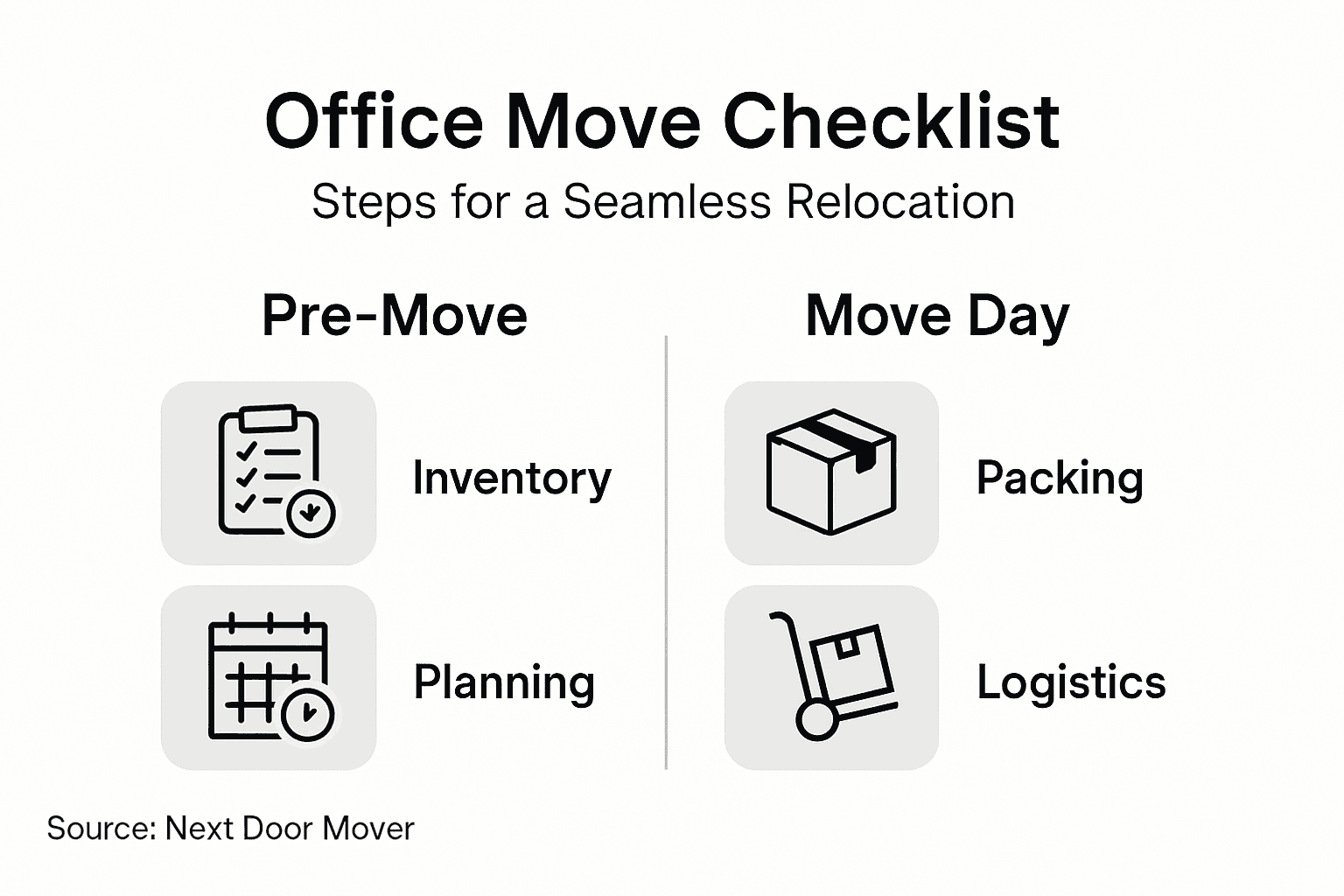
Create a master checklist that encompasses every critical moving component. This document should include detailed timelines, contact information for key personnel, specific equipment handling instructions, and contingency plans for potential unexpected scenarios. Review the checklist with your moving coordinator and internal stakeholders to ensure everyone understands their responsibilities and potential challenges. Conduct a final verification meeting with your professional moving team to confirm truck arrival times, loading sequences, and specific handling instructions for sensitive equipment or fragile items.
Pro tip: Prepare a digital backup of all critical documents and create a mobile communication group to enable real-time updates and rapid problem solving during the moving process.
Step 5: Verify setup and resume business operations
Successfully transitioning to your new office space requires a methodical approach to verifying infrastructure and minimizing operational disruptions. Your primary objective is to ensure every system functions seamlessly and employees can immediately return to full productivity.
Successfully resuming operations demands comprehensive system and workspace verification. Begin with a systematic technology infrastructure check that includes testing network connectivity, phone systems, internet bandwidth, and all computer workstations. Verify that electrical systems, security access points, and communication platforms are fully operational before bringing employees onsite. Conduct a detailed walkthrough with department heads to confirm each workspace meets functional requirements and supports team workflow.
Schedule an employee orientation session to familiarize staff with new workspace layouts, emergency protocols, technological setups, and logistical changes. Provide clear documentation and visual guides that help team members quickly navigate the new environment. Establish a centralized support system where employees can report any setup issues or logistical challenges they encounter during the first week. Monitor productivity metrics and be prepared to make rapid adjustments to ensure minimal disruption to business operations.
Here’s a quick reference guide to essential post-move verification steps:
| System/Area | What to Verify | Why It Matters |
|---|---|---|
| Network & Internet | Connectivity and bandwidth | Enables daily operations |
| Security Systems | Access control and functionality | Protects office and assets |
| Workstations | Hardware setup, software access | Ensures staff productivity |
| Emergency Protocols | Clear evacuation and signage | Employee safety compliance |
Pro tip: Designate a dedicated transition coordinator to handle real-time problem solving and provide immediate support during the first week of relocation.
Make Your Office Relocation Easy and Stress-Free with Next Door Mover
Moving an office can bring many challenges like coordinating detailed logistics, managing technology transfers, and ensuring every item is packed and labeled correctly as highlighted in the article on Moving Office Tips for Smooth Relocation Success. These steps often cause stress and disrupt daily business operations. That is why partnering with a reliable moving company that understands these complex needs is critical.
Next Door Mover specializes in professional commercial moves in New Jersey, offering comprehensive services that handle everything from packing and unpacking to specialty item transport and reassembly. We focus on minimizing disruption to your business and making sure your office setup is ready for productivity from day one.

Ready to experience a stress-free office relocation with expert movers who care about your deadlines and business continuity? Visit Next Door Mover today to request a free quote or learn more about our tailored commercial moving solutions. Don’t wait until moving day—plan ahead for a smooth transition by contacting trusted professionals now.
Frequently Asked Questions
How should I assess my office inventory before moving?
Start by conducting a thorough walkthrough of your current office space, documenting all equipment, furniture, and technology. Create a detailed inventory that categorizes items to move, replace, or discard within the next few weeks to streamline your relocation planning.
What are the key components of a moving plan?
A successful moving plan includes clear communication with stakeholders, a project management document outlining tasks and responsibilities, and a contingency plan for emergencies. Schedule a kickoff meeting to discuss the move timeline and create dedicated teams for various aspects of the relocation.
How can I effectively delegate packing responsibilities?
Assign packing tasks to team members based on their familiarity with office equipment, and use a consistent labeling system for boxes. Provide standardized packing materials and set a deadline for packing completion to ensure everything is organized well before the moving day.
What final checks should I conduct before the move?
Conduct comprehensive final checks, including technology infrastructure readiness and parking arrangements. Create a master checklist that covers timelines, key contacts, and specific handling instructions for sensitive items to ensure nothing is overlooked on moving day.
How do I ensure a smooth transition to the new office?
Verify all systems, including network connectivity and workstations, are functioning properly before employees arrive. Schedule an employee orientation to help staff adjust to new layouts and establish a centralized support system for addressing immediate concerns during the first week.
What post-move verification steps should I take?
After the move, systematically check all systems, from network services to emergency protocols, to confirm they are operational. Designate a transition coordinator to assist with any issues and ensure that productivity is restored within the first few days.